
Watched The Elephant Whisperers on Netflix —winner of the Academy Award for Best Documentary—and I couldn’t stop sobbing. I rarely cry, but something about that film overpowered me. It touched a nerve so deep that the only way I could process those emotions was by writing this blog. I saw myself in that story.
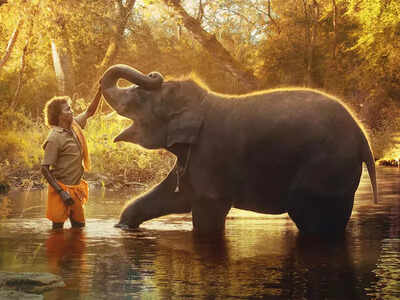
My story is a little different, though. I wasn’t an elephant whisperer—I was a cow whisperer. Yes, for over ten long years of my childhood, I cared for cows. I identified myself as a Govaliyo—one who tends to cows—just like Bhagwan Krishna, whose father Nand was also a Gwal (Goval). When talking to friends in North America, I call myself a “cowboy”—because, well, it sounds cooler. Some of my friends laugh when they hear this. They think I’m joking or exaggerating. But this is no fiction; this is my childhood, my truth.
From the moment I was born until the age of 13, my family kept cows. And this wasn’t in a rural village—it was in Ahmedabad, one of India’s most urbanized cities. In a neighborhood with no trace of farmland, my childhood stood out like a tree in the desert. I didn’t belong to traditional cattle-rearing communities like the Rabaris or the Maldharis. My father was a businessman, and my grandfather was a respected professor at Gujarat University. So, how did I end up growing up among cows? I have had always wondered as a child: How come this twist of destiny that I find myself playing with this cows? Looking into the past, I find myself very fortunate for “the different childhood” I had.
It all began with a quiet wish—around 1995 or 1996—expressed by my grandfather, a professor of world history and politics. He hoped the family could keep a cow. His reasons were simple yet profound: so that his grandchildren could drink pure cow’s milk, consume fewer processed foods, and uphold the Vedic values he cherished. In Hindu Vedic traditions, the cow is sacred—respected as a mother figure and vital to life. My grandmother, pretty empowered woman for her time, used to tell me stories of her childhood in our native village, Thasra, where she rode her uncle’s horse and where cows were a natural part of life.
Thasra, nestled between the holy towns of Dakor and Galteshwar—home to the Ranchodrai and Shiva temples—is a land steeped in spiritual and pastoral traditions. A place beautifully located between Dakor, with the Ranchodrai Temple and Galteshwar with an ancient Shiva temple on the banks of Mahi River. In our culture, cows have always been more than animals—they’re companions in agriculture, providers of nourishment, and even shelter. Their worship dates back to the times of Bhagwan Krishna and even before that. My grandfather had also witnessed the Gujarat famine of 1987 and others like it, where the most heartbreaking sight was that of abandoned, starving cattle. That memory stayed with him.
Despite his wish, no one acted on it immediately. It was just a passing conversation at the dinner table. Years rolled on. Gujarat, being a semi-arid state, often faces droughts. In regions like Kutch and North Gujarat, a drought every three to four years was considered routine. While cities like Amdavad, Vadodara, and Surat had relatively stable water supplies due to urban water management and treatment systems, rural areas suffered terribly. Wells ran dry. Rivers and ponds disappeared. Groundwater was hard to find. I remember how, even in urban Ahmedabad, some households and slums lacked running water and would queue at public fountains, municipal buildings or go door-to-door for a few buckets. Thankfully, the situation is much better today.
Then, a few months after I was born, a severe drought struck Kutch and North Gujarat again. Water and fodder became almost nonexistent. Rabaris and Maldharis—who depend entirely on their livestock—were left with no choice but to sell or abandon their cattle. The animals grew emaciated, their ribs showing, their spirits broken. It was heartbreaking. When no buyers came forward, many were sold to butchers.
One such truck, filled with weak, malnourished cows, stopped near the Shyama Prasad Mukherjee bridge close to our home in Ahmedabad. My father happened to be passing by. He spoke to the families who had brought the cows from drought-stricken districts like Mahesana, Banaskantha, and Sabarkantha. They were desperate—pleading with people to take the cows, to save them from abandonment or slaughter. Their crops had failed. They needed the money. They had nowhere else to turn.
My father thought of his own father’s wish. Just a year earlier, my grandfather had passed away from kidney failure after months of painful treatments. Our family was struggling financially, having spent nearly everything on dialysis and other medical bills. Yet, in that moment, my father chose compassion. With whatever little money he had left, he bought one cow.
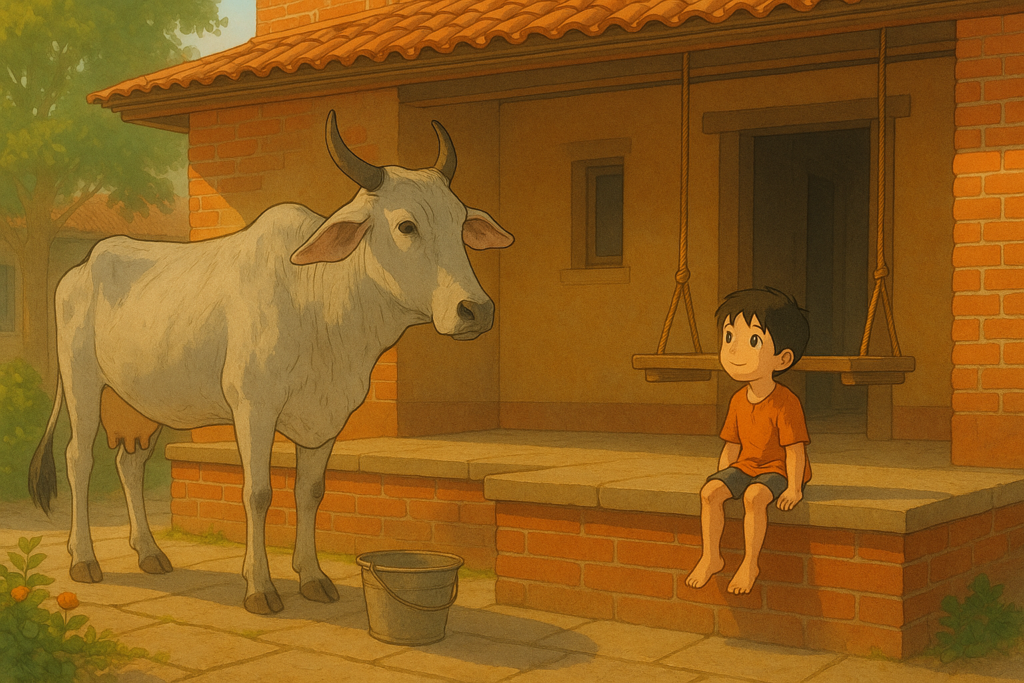
I still remember her vividly—a fragile, greyish-white Kankrej cow with long, curved horns. That was the beginning. My first cow. The first step into a very different kind of childhood.
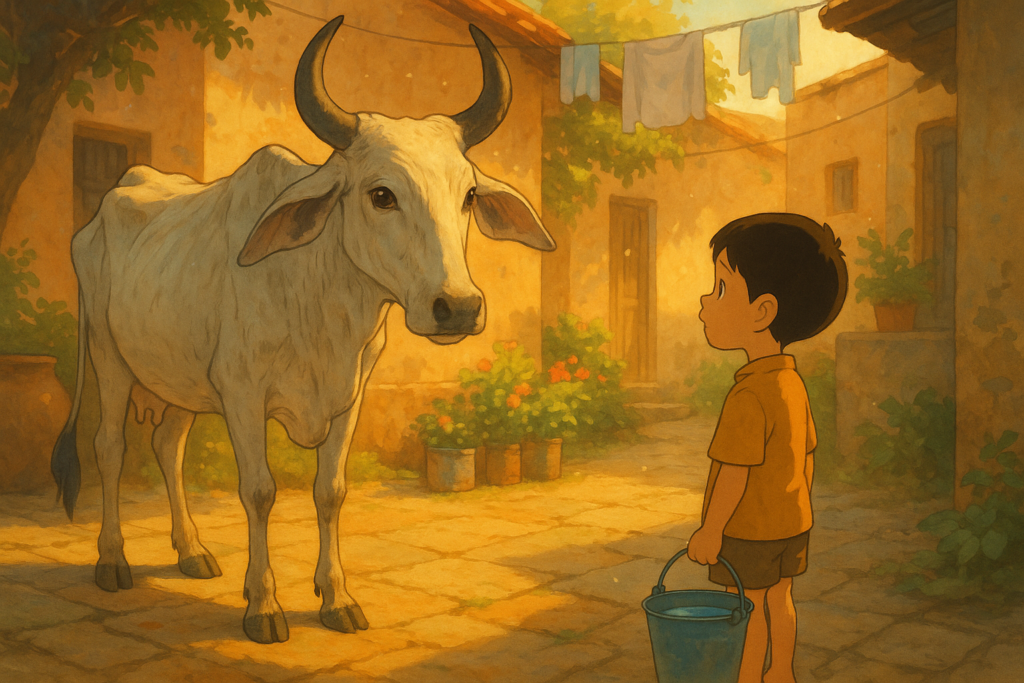
She had huge horns, She was huge, for me, and I liked her kid, my Baboo, more than her, but that’s a story for another day.
PS: Thank you for reading!! Please feel free to share your thoughts and comments.
I wish I had photos of my cows but I don’t have photos of any of my cows as I only had my first camera phone, when I was 17 years old. But I love Studio Ghibli Art as it helps me recreate my childhood memories in the best possible way!